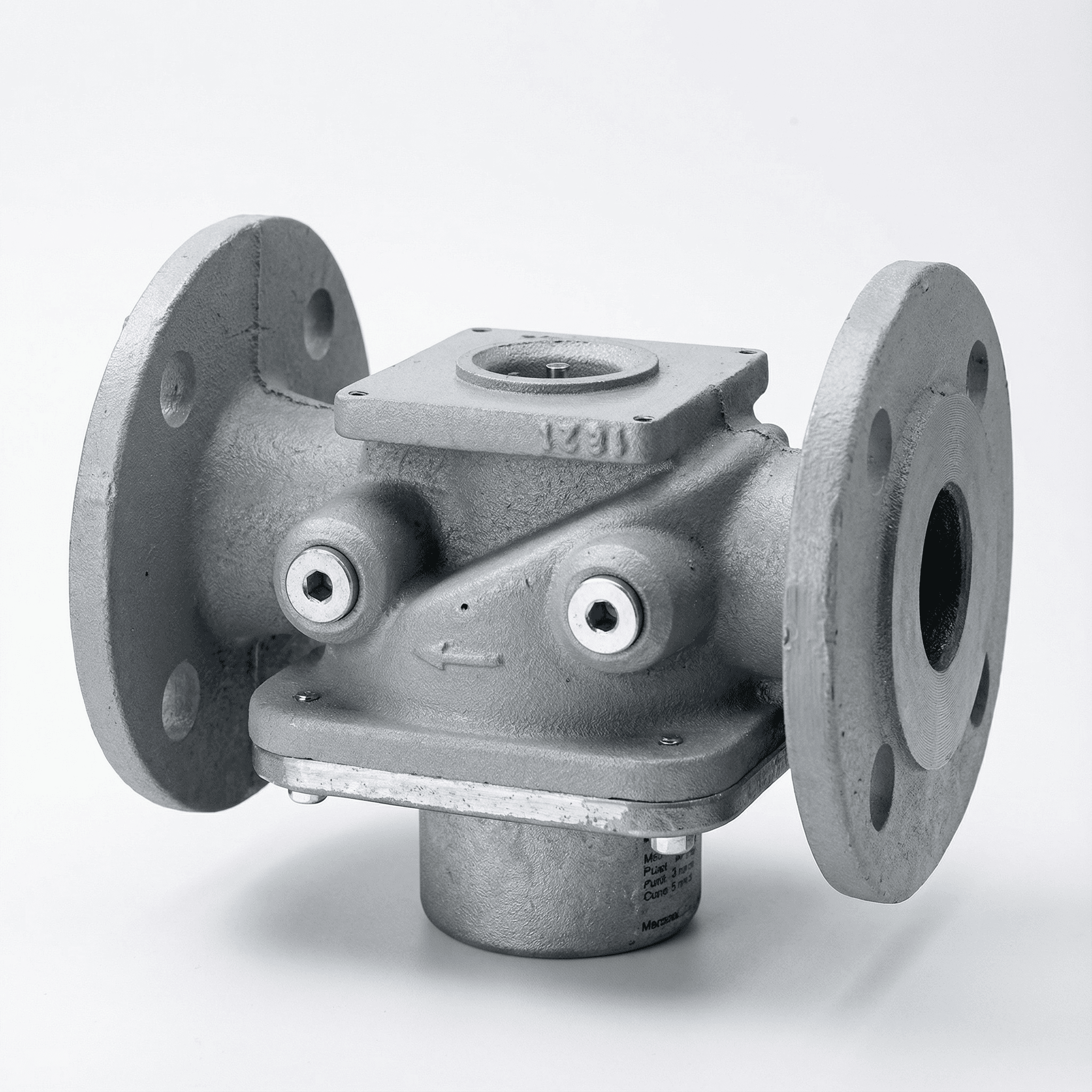
Siemens VRF Series
Precision Proportional Gas Control Valves for Modulating Burners. Enabling fine adjustment and optimized combustion.
What is the Siemens VRF Series?
The Siemens VRF Series consists of proportional gas control valves designed for precise fuel flow modulation in industrial combustion systems.
Unlike basic regulating valves that provide coarse adjustment, VRF valves enable finer control of gas flow in response to actuator positioning, supporting optimized air-fuel ratio management.
Position Within Combustion Architecture
In a typical industrial burner gas train:
- Gas supply stabilization is handled by pressure regulators (VRD)
- Safety isolation is ensured by shutoff valves (VGD)
- Fuel flow regulation is performed by control valves (VRF)
The VRF Series enables proportional fine adjustment, allowing the valve to function as a precision control component within advanced combustion systems.
Why Proportional Gas Control Matters
Precise gas flow adjustment supports:
- Stable flame characteristics: Consistent heat release.
- Improved combustion efficiency: Optimized air-fuel mixture.
- Reduced fuel consumption: Minimizing waste.
- Lower emission levels: Cleaner combustion.
- Smooth load transition: Seamless modulation in burners.
Typical Applications
VRF Series valves are commonly applied in:
- Industrial modulating gas burners
- Commercial boiler combustion systems
- Process heating installations
- High-efficiency furnace systems
- Emission-sensitive combustion applications
Precise Modulation
Finer control resolution for exacting air-fuel ratio requirements.
High Efficiency
Optimizes combustion performance by matching fuel delivery to load.
Industrial Design
Rugged construction suitable for continuous industrial operation.
Servo Integration
Engineered for seamless mechanical linkage with SQM actuators.
Core Functional Characteristics
All VRF Series valves share the following principles:
- Designed for proportional control: Linear flow characteristics.
- Servo actuator compatibility: Direct coupling with SQM actuators.
- Stable flow across modulation: Consistent performance at partial loads.
- Industrial-grade construction: Durable mechanical design.
- Fuel flexibility: Suitable for natural gas and comparable industrial fuels.
Valve opening position directly influences gas throughput, enabling dynamic fuel adjustment in real-time response to process demand.
All VRF Models
Integration with Actuator and Control Systems
VRF Series valves are typically integrated with:
- Siemens SQM Series servo actuators
- Siemens burner management systems
- Pressure stabilization components
- Flame supervision systems
The actuator controls the valve opening, while the control unit defines the modulation logic based on load demand.
Selection Considerations
When selecting a VRF proportional gas valve, consider:
- Required fuel modulation range: Determine turndown ratio needs.
- Maximum burner heat input: Match valve Cv/Kv.
- Operating gas pressure: Ensure rating compliance.
- Combustion performance requirements: Precision vs. standard regulation.
Correct valve sizing ensures stable combustion behavior across full load variation.
Selection Guide
Confirm required turndown ratio and precision.
Select Kv value matching maximum burner load.
Ensure compatibility with SQM actuator torque.
Technical Support
Need help with valve sizing? Our experts can assist with flow calculations.
Contact an ExpertFrequently Asked Questions
What is the primary function of the Siemens VRF Series?
The Siemens VRF Series is designed to provide precise and reliable control for industrial combustion systems, ensuring optimal performance, safety, and energy efficiency across various heating applications.
How do I select the right model within the VRF Series?
Selecting the correct model depends on your specific application requirements, including operating voltage, required torque or capacity, and control logic (e.g., on-off vs. modulating). Refer to the model overview table above or contact our engineering team for technical assistance.
Are VRF Series components suitable for retrofitting existing systems?
Yes, Siemens designs the VRF Series with standardization in mind, making them excellent choices for both new installations and retrofitting older or legacy combustion systems to meet modern safety and emissions standards.