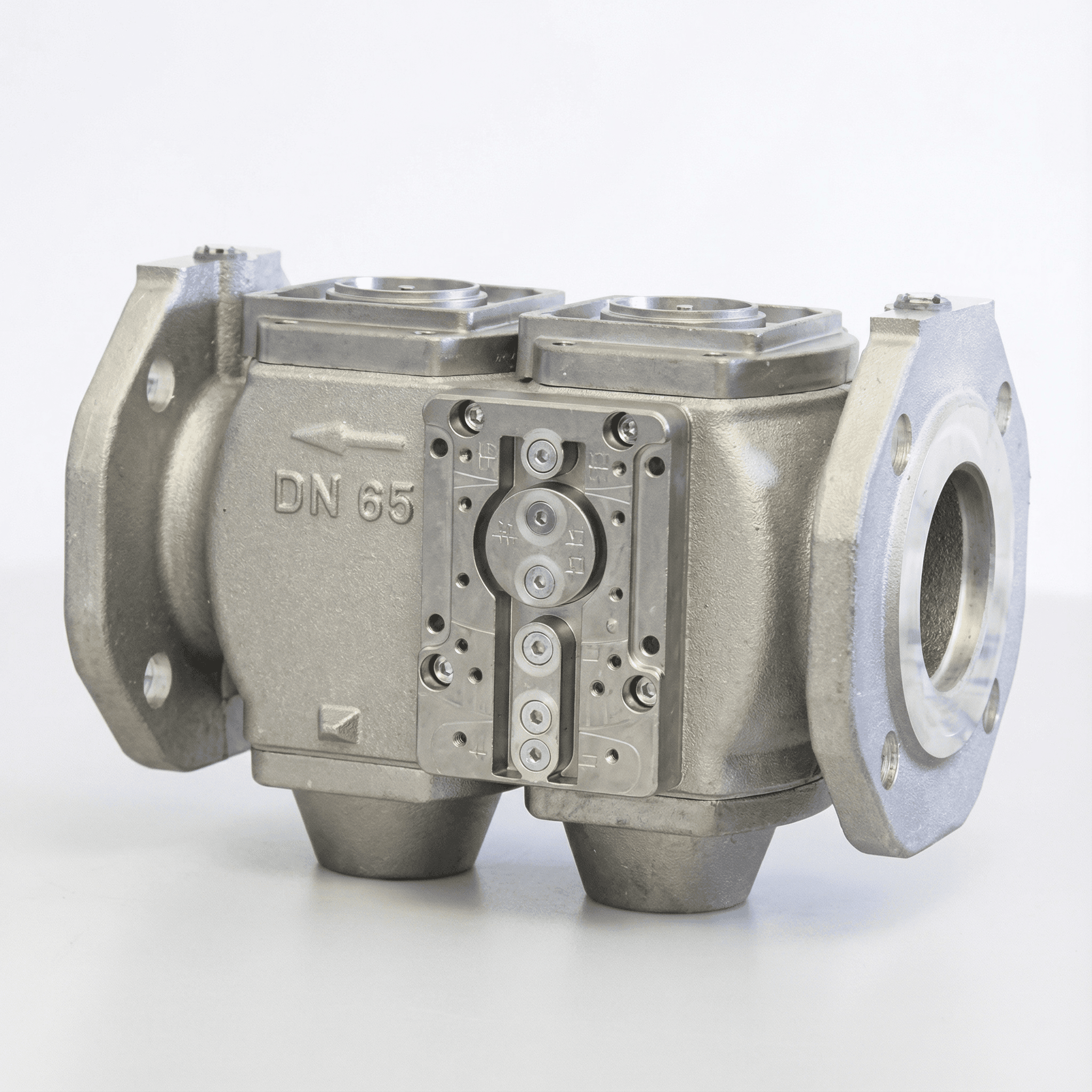
Siemens VKF Series
Gas Solenoid Valves for Industrial Burner Fuel Safety Control. Reliable fuel shut-off and admission for combustion systems.
What is the Siemens VKF Series?
The Siemens VKF Series consists of gas solenoid valves designed for fuel shut-off and control in industrial and commercial burner systems. These valves function as safety-relevant fuel control components within combustion systems. They are electrically actuated and operate as part of the burner safety chain, ensuring that fuel gas is only released when all required safety conditions are satisfied.
Within a combustion control architecture, the VKF Series is positioned as a controlled fuel admission device, directly governed by the burner control unit.
How does the Siemens VKF Series work?
In a typical industrial gas burner configuration, VKF solenoid valves operate together with:
- Burner control units (e.g., LME, LDU, LMV systems)
- Gas pressure switches (e.g., QPD Series)
- Air pressure switches (e.g., QPL Series)
- Flame supervision devices (e.g., LFS Series)
Operational sequence:
- Airflow and gas pressure verified.
- Burner controller initiates ignition.
- VKF solenoid valve opens to allow fuel supply.
- Flame detection confirms ignition.
- Continuous supervision maintained.
If any safety condition fails, the burner control unit immediately de-energizes the VKF valve, closing fuel supply. This positions the VKF Series as a core element in fuel safety management.
Typical Applications
VKF Series gas solenoid valves are commonly used in:
- Industrial gas burners
- Commercial gas-fired boilers
- Process heating systems
- Furnace and oven combustion systems
- Dual-fuel burner installations (gas supply side)
They are suitable for installations where rapid and reliable gas shut-off is required.
Safety Shut-Off
Normally closed design ensures immediate fuel interruption upon power loss or safety trip.
Industrial Design
Robust construction engineered for reliability in demanding industrial combustion environments.
Core Technical Characteristics
While specific models differ in size and configuration, VKF Series valves typically feature:
- Electromagnetic Actuation: Reliable solenoid operation for fast response times.
- Normally Closed Configuration: Failsafe design ensures valve closure on power loss.
- Fast Opening / Closing: Rapid response to control signals for precise ignition and shut-off.
- Industrial Construction: Robust design for longevity in demanding environments.
- Safety Compliance: Engineered to meet strict combustion safety requirements.
Model Differentiation Logic
Different VKF models are defined primarily by:
- Nominal diameter (flow capacity)
- Operating pressure range
- Electrical voltage specification
- Connection type (Flanged / Threaded)
- Flow characteristics
Model selection depends on burner capacity, gas supply pressure, and required shut-off response time.
All Models
Safety Chain Positioning
Within combustion system architecture, the VKF Series performs:
Fuel Admission Control → Safety Shut-Off → System Protection
Safety logic flow:
- System safety conditions verified.
- VKF valve energized to allow gas flow.
- Continuous flame supervision active.
- If fault detected, VKF valve immediately closes.
This makes the VKF Series a critical fuel control element in combustion safety chains.
Selection Guide
Designed for modulating control of gas flow in combustion systems.
VKF11 offers enhanced regulation characteristics for precise burner control.
Robust construction suitable for continuous industrial operation.
Valve Sizing Support
Ensure proper flow capacity and pressure ratings. Our team can help size the correct valve for your application.
Contact an ExpertFrequently Asked Questions
What is the primary function of the Siemens VKF Series?
The Siemens VKF Series is designed to provide precise and reliable control for industrial combustion systems, ensuring optimal performance, safety, and energy efficiency across various heating applications.
How do I select the right model within the VKF Series?
Selecting the correct model depends on your specific application requirements, including operating voltage, required torque or capacity, and control logic (e.g., on-off vs. modulating). Refer to the model overview table above or contact our engineering team for technical assistance.
Are VKF Series components suitable for retrofitting existing systems?
Yes, Siemens designs the VKF Series with standardization in mind, making them excellent choices for both new installations and retrofitting older or legacy combustion systems to meet modern safety and emissions standards.