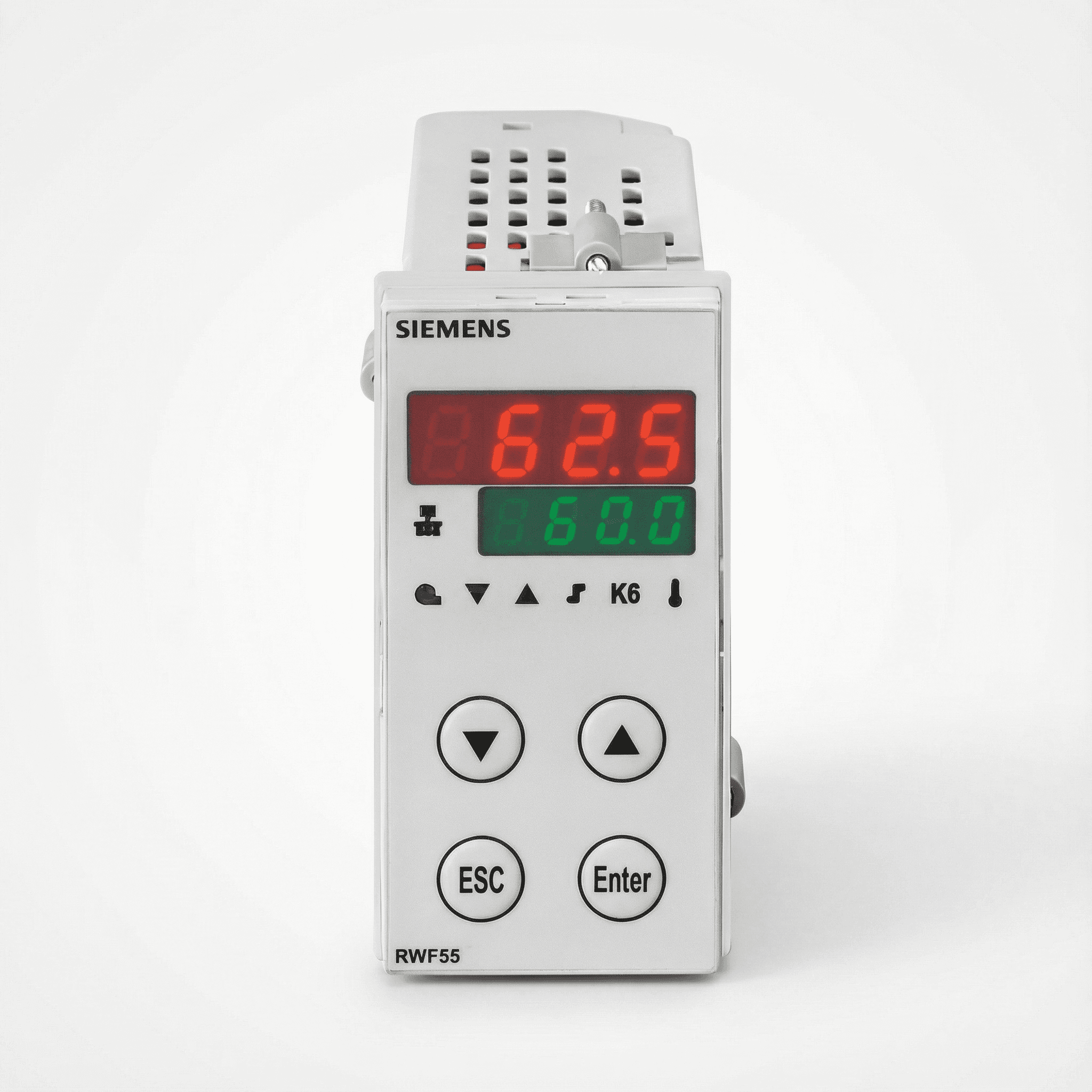
Siemens RWF Series
Industrial Temperature and PID Controllers for Burner Modulation Systems. Achieving precise thermal stability through advanced regulation.
What is the Siemens RWF Series?
The Siemens RWF Series consists of industrial temperature and process controllers designed for precise combustion modulation and thermal process regulation. Unlike burner safety control units that manage ignition and flame supervision, RWF controllers operate at the regulation layer of a combustion system.
Their primary function is to maintain stable temperature or process values through proportional-integral-derivative (PID) control logic. Within an industrial combustion architecture, the RWF Series is positioned as a modulation controller that adjusts burner output to maintain defined setpoints.
How does the Siemens RWF Series work?
In a typical modulating burner configuration, the RWF controller works alongside:
- Burner management systems (e.g., LMV platforms)
- Gas control valves (e.g., VKP Series)
- Actuators and damper motors (e.g., SQN / SKP types)
- Temperature or pressure sensors
- Safety components (QPL / QPD / LFS)
Operational control logic:
- Desired temperature setpoint defined.
- Process sensor measures actual value.
- RWF PID controller calculates deviation.
- Control signal adjusts gas valve and air damper.
- Burner output modulates to stabilize system temperature.
The RWF Series therefore governs performance control rather than safety supervision.
Typical Applications
RWF Series controllers are widely applied in:
- Industrial boiler systems
- Process heating equipment
- Thermal oil heaters
- Industrial ovens and furnaces
- Combustion systems requiring temperature stability
They are particularly suitable for applications requiring continuous modulation and precise thermal control.
PID Precision
Advanced proportional-integral-derivative algorithms minimize temperature overshoot and oscillation.
Universal Input
Compatible with a wide range of industrial temperature sensors and process transmitters.
Core Technical Characteristics
Although specific models vary in configuration, RWF Series controllers typically include:
- PID Control: Advanced algorithms for precise process regulation.
- Adjustable Setpoints: Flexible configuration for different process requirements.
- Universal Inputs: Compatibility with various temperature and pressure sensors.
- Output Options: Relay or analog modulation outputs to suit actuator types.
- Process Display: Clear visualization of actual value and setpoint.
- Industrial Design: Built for stable long-term operation in thermal process environments.
Model Differentiation Logic
Different RWF models are distinguished by:
- Input type (temperature, pressure, process signal)
- Output configuration (relay, analog modulation)
- Control range
- Display and interface options
- Communication capabilities (in advanced variants)
Model selection depends on burner modulation requirements, sensor compatibility, and required precision level.
Control Architecture Positioning
Within a combustion system structure:
Safety Layer (QPL/QPD/LFS) → Burner Management (LME/LMV) → Modulation Layer (RWF)
Operational hierarchy:
- Safety Verified
- Burner Management Active
- Fuel & Air Controlled
- PID Regulation (RWF)
- Stable Thermal Output
This clarifies that the RWF Series operates as a process regulation controller within a safety-supervised combustion environment.
All Models
Universal Controller
Advanced Universal Controller
Selection Guide
Standard PID controller for temperature and pressure regulation in heating plants.
Enhanced controller with additional functions, communication options, and analog inputs.
PID Tuning Support
Struggling with temperature stability? Our team can assist with controller selection and parameter tuning.
Contact an ExpertFrequently Asked Questions
What is the primary function of the Siemens RWF Series?
The Siemens RWF Series is designed to provide precise and reliable control for industrial combustion systems, ensuring optimal performance, safety, and energy efficiency across various heating applications.
How do I select the right model within the RWF Series?
Selecting the correct model depends on your specific application requirements, including operating voltage, required torque or capacity, and control logic (e.g., on-off vs. modulating). Refer to the model overview table above or contact our engineering team for technical assistance.
Are RWF Series components suitable for retrofitting existing systems?
Yes, Siemens designs the RWF Series with standardization in mind, making them excellent choices for both new installations and retrofitting older or legacy combustion systems to meet modern safety and emissions standards.