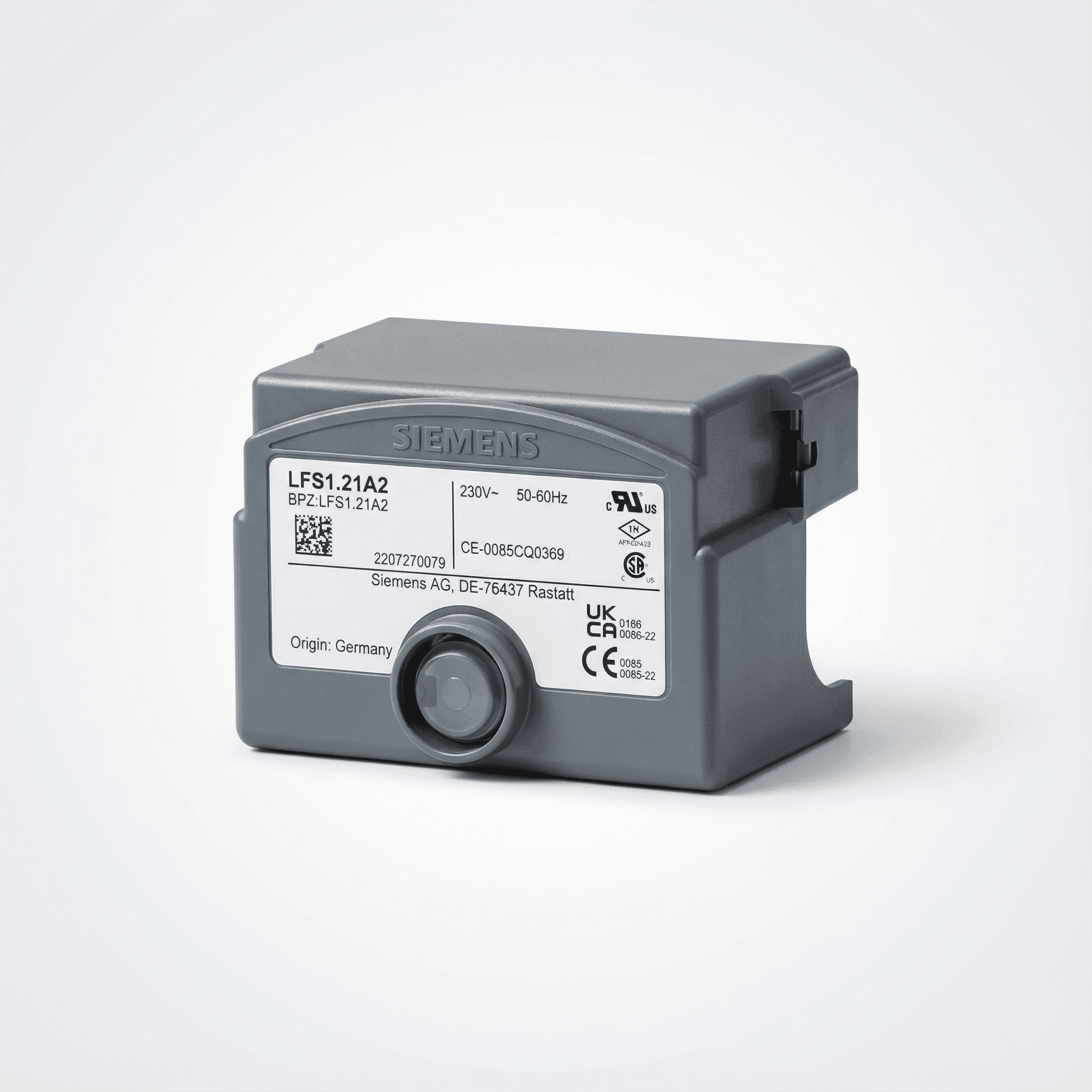
Siemens LFS Series
Flame Detectors for Industrial Burner Supervision Systems. Ensuring stable flame establishment and reliable safety shut-off.
What is the Siemens LFS Series?
The Siemens LFS Series consists of flame detection devices designed for continuous flame supervision in industrial and commercial combustion systems. These devices monitor the presence and stability of flame during burner operation and serve as a critical safety element within the burner control architecture.
If flame loss is detected during ignition or operation, the LFS detector signals the burner control unit to immediately shut off fuel supply, preventing unsafe combustion conditions. The LFS Series is therefore positioned as a safety-relevant flame supervision component within industrial burner systems.
How does the Siemens LFS Series work?
In a typical industrial combustion control setup, the LFS flame detector operates together with:
- Burner control units (e.g., LME, LDU, LMV platforms)
- Ignition transformers
- Gas valve assemblies
- Air and gas pressure monitoring devices (QPL / QPD)
During operation, the burner control initiates ignition and the flame detector verifies flame establishment. Continuous monitoring confirms flame stability. If flame failure occurs at any time, the safety circuit is interrupted, fuel valves close, and the system enters lockout mode.
Typical Applications
LFS Series flame detectors are commonly used in:
- Industrial gas burners
- Commercial boiler systems
- Process heating equipment
- Furnaces and ovens
- Oil or dual-fuel combustion systems
They are particularly suitable for applications requiring reliable flame supervision under industrial operating conditions.
Fast Response
Immediate flame failure detection ensures fuel shut-off within milliseconds for maximum safety.
Safety Certified
Designed and calibrated specifically for combustion flame recognition in industrial environments.
Flame Detection Technologies
Different LFS models may utilize varying detection principles to suit different fuel types and burner configurations:
- UV Flame Detection: Ideal for oil and gas industrial burners where high intensity sensing is required.
- Ionization (Flame Rod) Supervision: Commonly used for gas-fired burners where the flame conductivity is measured.
- Optical Sensing Methods: Utilized in specific combustion chamber designs for accurate flame recognition.
Core Technical Characteristics
- Continuous Monitoring: Constant supervision of flame presence during the entire burner cycle.
- Fast Response: Immediate detection and signaling of flame failure to ensure system safety.
- Industrial-Grade Housing: Designed to operate reliably in high-temperature and vibration-prone environments.
- System Compatibility: Fully integrated with Siemens burner control platforms (LME, LDU, LMV).
All Models
Safety Chain Positioning
Within the combustion safety architecture, the LFS Series performs:
Flame Verification → Safety Confirmation → Continuous Supervision
Operational safety flow:
- Airflow verified (QPL).
- Gas pressure verified (QPD).
- Ignition initiated.
- LFS confirms flame presence.
- Continuous monitoring maintained throughout operation.
If flame failure occurs at any time, the system shuts down immediately. This makes the LFS Series one of the most critical safety components in the burner control chain.
Selection Guide
Choose ionization-based models for stable flame characteristics in gas applications.
Select UV flame detectors for high-intensity industrial oil or dual-fuel burners.
Consider industrial-grade variants with enhanced environmental resistance.
Expert Support
Need help choosing the right flame detection technology? Our technical team is ready to assist.
Contact an ExpertFrequently Asked Questions
What is the primary function of the Siemens LFS Series?
The Siemens LFS Series is designed to provide precise and reliable control for industrial combustion systems, ensuring optimal performance, safety, and energy efficiency across various heating applications.
How do I select the right model within the LFS Series?
Selecting the correct model depends on your specific application requirements, including operating voltage, required torque or capacity, and control logic (e.g., on-off vs. modulating). Refer to the model overview table above or contact our engineering team for technical assistance.
Are LFS Series components suitable for retrofitting existing systems?
Yes, Siemens designs the LFS Series with standardization in mind, making them excellent choices for both new installations and retrofitting older or legacy combustion systems to meet modern safety and emissions standards.